> For the complete documentation index, see [llms.txt](https://integrations.drivetrain.ai/llms.txt). Markdown versions of documentation pages are available by appending `.md` to page URLs; this page is available as [Markdown](https://integrations.drivetrain.ai/extending-drivetrain/integration-for-slack.md).
# Integration for Slack
Learn how to connect Slack as a notification channel and receive Drivetrain notifications in Slack.
Connect Slack to your Drivetrain tenant to receive Drivetrain notifications as Slack direct messages, and to ask Drive AI questions with [the Drivetrain Slackbot](/extending-drivetrain/integration-for-slack/using-the-drivetrain-slackbot.md).
The connection is tenant-wide: an admin connects it once, and it works for every user in the tenant whose Slack email matches their Drivetrain email.
This page covers:
* [Before you begin](#before-you-begin)
* [Connecting Slack](#connecting-slack)
* [What the Slack toggle controls](#what-the-slack-toggle-controls)
* [Disconnecting Slack](#disconnecting-slack)
* [Viewing notifications in Slack](#viewing-notifications-in-slack)
* [Permissions Drivetrain requests in Slack](#permissions-drivetrain-requests-in-slack)
* [Troubleshooting](#troubleshooting)
* [FAQ](#faq)
## Before you begin
{% hint style="info" %}
To connect Slack, you need:
1. Admin access in Drivetrain. **Notification channels** appears in **Settings** only for admins. If you're an admin and don't see it, it isn't enabled for your tenant yet. Contact support.
2. Permission to install apps in your Slack workspace.
{% endhint %}
Each user gets notifications only if the email on their Slack profile matches the email they use to sign in to Drivetrain. Users added later are matched automatically the first time Drivetrain sends them a notification.
## Connecting Slack
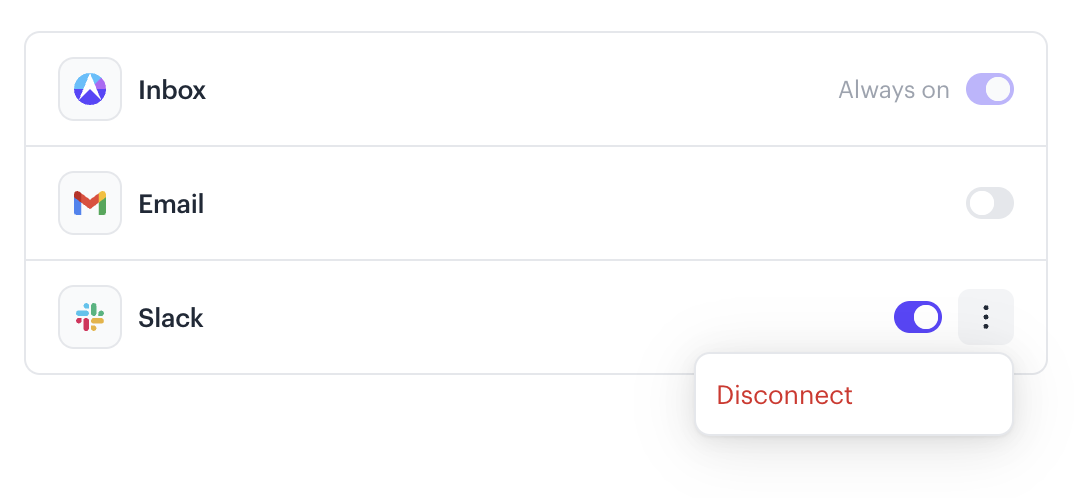
Drivetrain manages Slack alongside your other notification channels. Your **Inbox** is always on.
To connect Slack:
1. Hover over your profile icon at the bottom of the left sidebar and click **Settings**.
2. Under **Advanced**, select **Notification channels**.
3. In the **Notification channels** panel, click **Connect** next to **Slack**.
4. In the Slack tab that opens, review the permissions and click **Allow**.
Slack confirms with the message "Integration for Slack completed successfully! You may close this window now."
5. Return to your Drivetrain tab, refresh the page, and reopen **Notification channels**. The **Slack** row now shows a toggle.
6. To also send list and dimension alerts to Slack, turn on the **Slack** toggle. See [What the Slack toggle controls](#what-the-slack-toggle-controls).
Comment, sharing and Drive AI message notifications start as soon as step 4 completes.
**Important:** If you use multiple tenants, connect Slack on each tenant using the steps above. You receive notifications only from the last tenant you connected.
## What the Slack toggle controls
The **Slack** toggle in **Notification channels** is a tenant-wide setting, off by default, that only admins can change.
| Notification | Sent to Slack |
| ----------------------------------------------------------------------------------------------- | ------------------------------------ |
| Comments, mentions and conversation updates on boards and models, and mentions in task comments | Whenever Slack is connected |
| A board shared with you | Whenever Slack is connected |
| A message someone sends you through Drive AI | Whenever Slack is connected |
| List and dimension alerts, if your tenant uses them | Only when the **Slack** toggle is on |
| Task updates (assigned, completed, sent for approval) | Never. Email and Inbox only |
To stop all Drivetrain notifications in Slack, [disconnect Slack](#disconnecting-slack).
## Disconnecting Slack
Disconnecting affects the whole tenant: no user receives Drivetrain notifications in Slack, and the Drivetrain Slackbot stops answering questions.
To disconnect Slack:
1. Navigate to **Settings → Notification channels**.
2. Open the overflow menu (⋮) next to **Slack** and click **Disconnect**.
3. In the **Disconnect Slack?** dialog, click **Disconnect**.
Disconnecting doesn't remove the Drivetrain app from your Slack workspace. To reconnect, follow the steps in [Connecting Slack](#connecting-slack).
## Viewing notifications in Slack
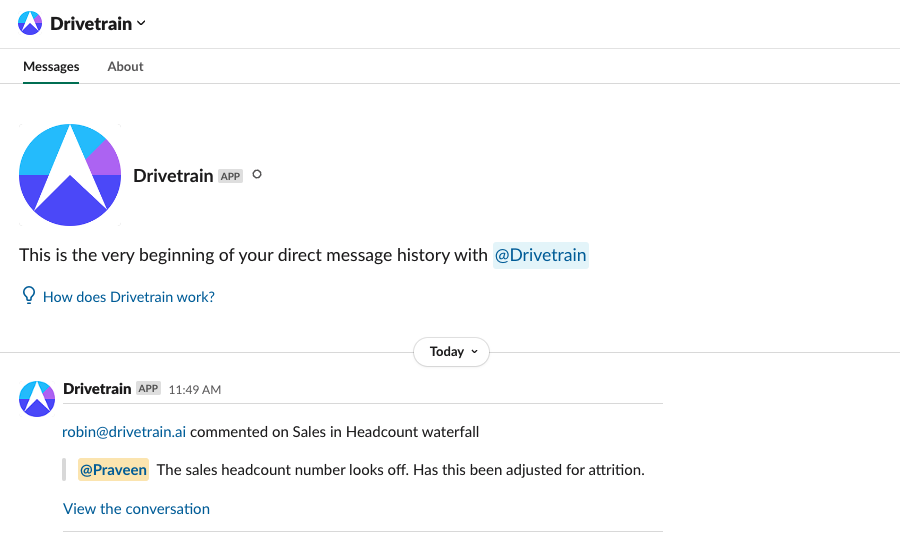
Drivetrain sends each notification as a direct message from the Drivetrain app. Each one shows:
* Who acted and what they did, for example "*Name* mentioned you in a conversation on *chart* in *board*" or "*Name* shared *Q3 Plan* board with you"
* A preview of the comment, up to 100 characters, when there is one
* A link: **View the conversation**, **Open board** for a shared board, or **Open Drivetrain** for a Drive AI message
You get comment notifications when:
* Someone mentions you in a comment on a board, model or task, in a public or private conversation
* Someone adds or edits a comment, adds you, or resolves the conversation, in a private conversation you're part of
You're never notified about your own comments. For the full list of events, see [Using the Drivetrain Slackbot](/extending-drivetrain/integration-for-slack/using-the-drivetrain-slackbot.md#receive-contextual-alerts).
## Permissions Drivetrain requests in Slack
When you click **Allow**, Drivetrain asks Slack for these bot permissions only:
| Slack scope | Used to |
| ------------------- | --------------------------------------------------------------------------- |
| `app_mentions:read` | See messages that mention **@Drivetrain**, so the Slackbot can answer |
| `chat:write` | Send notifications and Slackbot answers |
| `im:history` | Read direct messages sent to the Drivetrain app, so the Slackbot can answer |
| `users:read` | Look up Slack users |
| `users:read.email` | Match Slack users to Drivetrain users by email |
Drivetrain requests no user-level permissions and no permission to read channel history.
## Troubleshooting
| What you see | Cause | Fix |
| ------------------------------------------------------------------------------------------------------------------ | -------------------------------------------------------------------------------------------------------- | ------------------------------------------------------------------------------------------- |
| No **Notification channels** tile in **Settings** | You're not an admin, or the feature isn't enabled for your tenant | Ask an admin, or contact support. |
| **Disconnect MS Teams to connect Slack** on the **Slack** row | Microsoft Teams is connected | Disconnect Microsoft Teams first, then connect Slack. |
| "Microsoft Teams is already connected for this workspace; disconnect it before connecting Slack." in the Slack tab | Microsoft Teams is connected to your tenant | Disconnect Microsoft Teams, then connect Slack again. |
| An error in the Slack tab instead of the success message | You clicked **Cancel** in Slack, or the **Connect** link was already used or is more than 15 minutes old | Refresh the Drivetrain page, reopen **Notification channels**, and click **Connect** again. |
| The **Slack** row still shows **Connect** after you allowed access | The page hasn't reloaded | Refresh the Drivetrain page. |
| A user gets no notifications in Slack | Their Slack profile email differs from their Drivetrain sign-in email | Make the emails match. |
| No list or dimension alerts in Slack | The **Slack** toggle is off | An admin turns on the **Slack** toggle in **Notification channels**. |
## FAQ
Will I get notifications for public comments on boards and models I created?
Only if someone mentions you. On public comments, only the people mentioned are notified. In private conversations, everyone in the conversation is notified of new comments.
How do I stop all Drivetrain notifications in Slack?
Disconnect Slack using the steps in [Disconnecting Slack](#disconnecting-slack). Turning off the **Slack** toggle stops only list and dimension alerts.
Can I receive Drivetrain notifications in Microsoft Teams?
To connect Microsoft Teams, contact your Customer Success Manager. A tenant can use Slack or Microsoft Teams, not both.
**Support:** If you need help connecting or configuring Slack, reach out to your customer success manager or contact .
View our [Privacy Policy](https://www.drivetrain.ai/privacy-notice).
---
# Agent Instructions
This documentation is published with GitBook. GitBook is the documentation platform designed so that both humans and AI agents can read, navigate, and reason over technical content effectively. Learn more at gitbook.com.
## Querying This Documentation
If you need additional information that is not directly available in this page, you can query the documentation by asking a question.
Perform an HTTP GET request on the following URL with the `ask` and `goal` query parameters:
```
GET https://integrations.drivetrain.ai/extending-drivetrain/integration-for-slack.md?ask=&goal=
```
`ask` is the immediate question: it should be specific, self-contained, and written in natural language.
`goal` is what the user is ultimately trying to achieve, the reason they need the answer. Sharing it helps GitBook give you a better, more relevant answer. A goal is most helpful when it describes the outcome the user wants rather than restating the question. For example, with `ask=how do I create an API token`, a goal like `automate deployments from our CI pipeline` lets GitBook tailor the answer to that use case.
The response will contain a direct answer to the question and relevant excerpts and sources from the documentation.
Use this mechanism when the answer is not explicitly present in the current page, you need clarification or additional context, or you want to retrieve related documentation sections.